
Conveying System Design in Pet Food and Aquafeed Plants: How to Reduce Transfer Points
Learn how reducing transfer points can improve product handling, plant layout and conveying system design in pet food and aquafeed production.
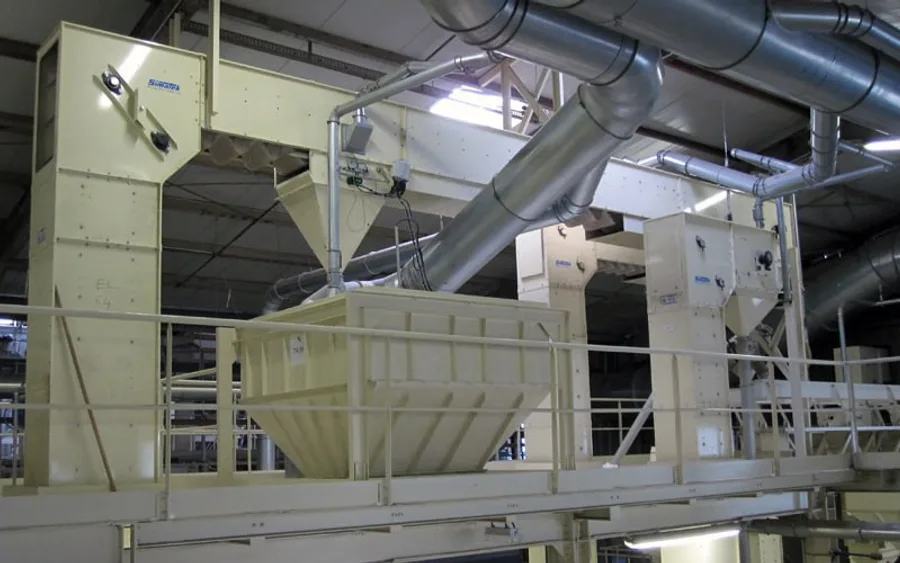
Look at the Conveying System as a Whole
When designing a conveying system for a pet food or aquafeed (fish feed) plant, individual pieces of equipment are often evaluated separately.
The elevator capacity is determined, conveyors are selected, chutes are designed and additional equipment is added to distribute the product.
However, when handling sensitive products, there is another important question:
How many machines and transfer points does the product pass through before reaching its final destination?
Every additional transfer can create another source of mechanical stress.
What Is a Transfer Point?
A transfer point is a location where product moves from one conveying component or machine to another.
For example:
Elevator → Conveyor → Distributor → Chute → Silo
In this arrangement, the product passes through several machines and transfer points.
During each transfer, the product may experience:
- free fall,
- impact,
- changes in direction,
- friction.
These effects may be acceptable for robust bulk materials such as grain, but require greater consideration when handling sensitive extruded pet food and aquafeed products.
More Equipment Does Not Always Mean a Better Solution
Achieving the required conveying capacity is only one part of system design.
Other factors should also be considered:
- number of machines,
- number of transfer points,
- free-fall heights,
- maintenance points,
- cleaning access,
- energy consumption.
Two conveying systems may therefore provide the same capacity while being very different from an overall process perspective.
The correct comparison is not simply “How much does the elevator cost?” A more comprehensive question is: “How many pieces of equipment are required to move the product from the inlet to all required destinations?”
How Can Reducing Transfer Points Help Preserve Product Quality?
In pet food and aquafeed production, sensitive products should be conveyed as gently as practical throughout the process.
For fragile extruded products, eliminating unnecessary transfers can help:
- reduce product breakage,
- reduce fines generation,
- limit unnecessary free fall,
- preserve product integrity.
You can review this subject in more detail in our article Breakage and Fines in Pet Food and Aquafeed Production.
The objective is not to eliminate every transfer point.
The objective is to identify transfers that are not necessary for the process and simplify the conveying concept wherever possible.
How Can a Z-Type Bucket Elevator Influence Plant Design?
Pendulum bucket elevators (Z-type bucket elevators) are not limited to purely vertical conveying.
Depending on the plant layout, the system can incorporate horizontal and vertical conveying sections.
Multiple controlled discharge points can also be incorporated into a single elevator — a subject covered in detail in our article Multiple Discharge in Pet Food and Aquafeed Plants.
In certain applications, these features may allow the functions of separate elevators, horizontal conveyors and distribution equipment to be integrated into a simpler conveying concept.
Depending on the application, this can help simplify:
- the number of conveying machines,
- transfer points,
- supporting structures,
- the overall product route.
Free-Fall Height Is Also Part of the Design
Reducing the number of transfers alone is not enough.
The way the product leaves one machine and enters the next piece of equipment or silo must also be considered.
A product may leave an elevator without damage but still break if it subsequently falls several metres into a silo.
For sensitive products, the following factors should therefore be evaluated together:
transfer points + free-fall height + conveying speed + discharge method
When Should the Conveying Concept Be Defined?
In a new pet food or aquafeed plant, the conveying concept should ideally be considered early in the design process.
If silo positions, production levels and packaging lines are fixed before the conveying concept is evaluated, fitting conveying equipment into the remaining space may create unnecessary machines or transfer points.
Considering the conveying system together with the plant layout may enable:
- shorter conveying routes,
- fewer transfer points,
- lower free-fall heights,
- simpler equipment arrangements.
Future capacity increases or additional packaging lines can also be considered during this stage.
Evaluating Total System Cost
Initial equipment cost is naturally an important consideration.
However, comparing the purchase price of a single machine may not always provide an accurate picture of the total investment.
The evaluation should also consider:
- additional conveyors,
- distributors and diverters,
- chutes,
- supporting structures,
- motors and drives,
- electrical and automation systems,
- maintenance requirements.
For this reason, comparing the total conveying system can provide a more meaningful basis for evaluating alternative concepts.
Conclusion
A good conveying system for pet food and aquafeed production is not simply one that provides the required capacity.
It should also aim to move the product from its starting point to its destination with:
- fewer unnecessary transfers,
- controlled discharge,
- reduced mechanical stress,
- a simplified equipment arrangement.
The horizontal and vertical conveying configurations and multiple-discharge capability of pendulum bucket elevators (Z-type bucket elevators) can help create simpler conveying concepts in suitable applications.
Therefore, the key question in conveying system design should not only be “Which elevator should we select?” It should be: “What is the most appropriate and efficient way to move the product through the entire process?”
Related Technical Articles
- Multiple Discharge in Pet Food and Aquafeed Plants: Advantages of Z-Type Bucket Elevators — Learn how a single pendulum bucket elevator can distribute products to multiple silos, bins and process destinations.
- Breakage and Fines in Pet Food and Aquafeed Production: How Conveying Systems Affect Product Quality — Learn how transfer points, conveying speed and free-fall height can influence sensitive products.
Explore our pendulum bucket elevators →
If you would like to review the conveying route and transfer points in your plant, get in touch with us — our engineering team will prepare a solution tailored to your project.