
Hygienic Conveying in Pet Food and Aquafeed Plants: Why Is Cleanability Important in Bucket Elevators?
Explore product residues, cross-contamination and cleaning requirements in pet food and aquafeed conveying systems, and why bucket elevator cleanability matters.
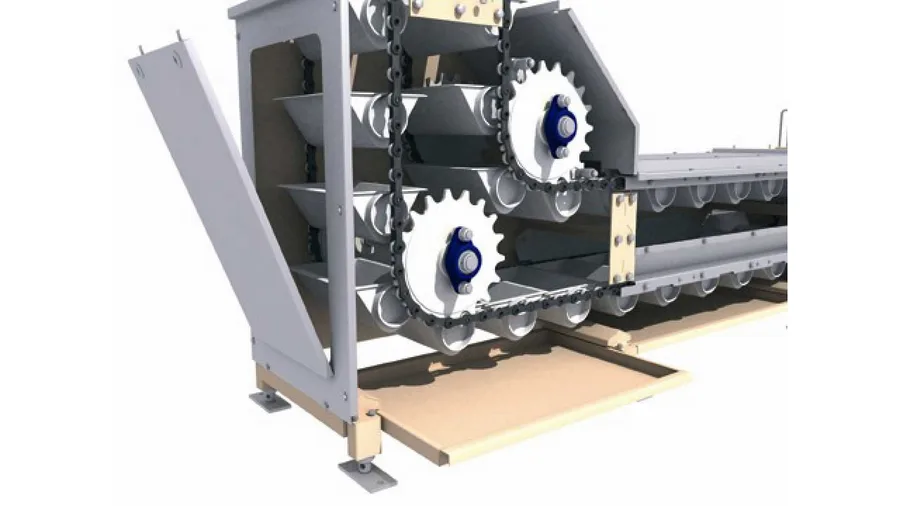
Product Quality Must Also Be Protected During Conveying
In pet food and aquafeed (fish feed) production, hygiene is often associated with processes such as raw material handling, extrusion, drying, oil coating and packaging.
However, between these processes, the product passes through various conveying systems. Bucket elevators, conveyors, chutes and bins are also process equipment that come into direct contact with the product.
Therefore, the role of a conveying system is not limited to moving the product from one point to another. The amount of residual product remaining inside the equipment, its cleanability and changeovers between different products should also be considered as part of the system design.
This becomes particularly important in plants where different formulations are produced on the same production line.
Why Do Product Residues Accumulate in Conveying Equipment?
After production, a certain amount of product may remain inside bulk material handling equipment.
Product can accumulate:
- In corners and connection points
- Around buckets or conveying elements
- In inlet and discharge areas
- Inside chutes
- On surfaces that are difficult to access
The level of risk depends on the physical characteristics of the product.
A dry, free-flowing material does not behave in the same way as pet food or aquafeed pellets with oil on their surfaces. Particularly after oil coating, the product surface may become more adhesive, allowing fines and small particles to adhere more easily to equipment surfaces.
For this reason, hygienic conveying design should consider not only the geometry of the equipment but also the characteristics of the product being conveyed.
Why Are Product Residues Important?
Residual product inside conveying equipment is not only a cleaning issue.
When the next production run begins, particles remaining from the previous product may be carried into the new batch.
For example, when different formulations are produced on the same line, residual material from the previous production run may mix with the next product. This should be taken into account particularly where formulation and ingredient control are important.
Organic product residues that remain inside equipment for extended periods may also create undesirable hygienic conditions.
An important question when evaluating conveying equipment is therefore:
How much product remains inside the system after production, and how easily can these areas be accessed for cleaning?
Cross-Contamination Risk
It is common for pet food and aquafeed plants to produce different products on the same production line.
During product changeovers, material remaining from the previous formulation can be carried into the next product. This is one potential source of cross-contamination.
The design of the conveying system plays a role in controlling this risk.
Reducing areas where product can accumulate, allowing the equipment to empty as completely as practical, and providing access to necessary cleaning points can make product changeovers more controlled.
It is important to consider not only the bucket elevator itself. The entire conveying route, including conveyors, chutes, distributors and bins, should be evaluated.
Why Can Oil-Coated Products Make Cleaning More Difficult?
In pet food and aquafeed production, oils or other liquid components may be applied to the product after extrusion and drying.
When oil-coated products are conveyed, the oil on the product surface can make it easier for fines and small particles to adhere to equipment surfaces.
Over time, this may lead to product residues accumulating in certain areas.
Therefore, two aspects should be considered together when conveying oil-coated pellets:
Handling the product with as little mechanical impact as practical and ensuring that the conveying equipment can be effectively cleaned.
Hygiene and gentle conveying are therefore not completely separate considerations.
What Should Be Considered in a Hygienic Conveying System?
Hygiene requirements vary depending on the plant and the product. However, several fundamental design criteria can be evaluated when selecting conveying equipment.
Areas where product can accumulate inside the equipment should be minimized wherever practical. Product-contact areas should also be accessible for maintenance and cleaning.
The ability of the equipment to empty effectively after production is another important consideration.
The design of buckets, inlet areas, discharge sections and return sections should also be evaluated from a cleanability perspective.
The objective is not simply to make the equipment cleanable, but to ensure that cleaning is practical under actual operating conditions.
An area that is theoretically cleanable but extremely difficult to access may not provide an effective solution in day-to-day production.
Hygiene and Cleanability in Z-Type Bucket Elevators
Pendulum bucket elevators (Z-type bucket elevators) are commonly considered for handling sensitive products such as pet food and aquafeed.
However, gentle handling alone does not automatically mean hygienic design.
When evaluating a system, several aspects should be considered together:
- Product-contact surfaces
- Bucket design
- Product inlet and discharge areas
- Locations where residual product may remain
- Access for cleaning and maintenance
For applications with higher hygiene requirements, dry cleaning may not be sufficient. In such cases, washable or CIP (Cleaning in Place) systems may need to be considered.
These systems involve additional technical requirements and should therefore be evaluated separately from standard cleanability.
Hygiene Should Be Considered at the Design Stage
Hygiene should not be treated merely as a maintenance issue to be addressed after the equipment has been installed.
Especially in new pet food and aquafeed plants, the cleaning concept should be defined during the design stage.
The products to be conveyed, frequency of product changeovers, presence of oil coating and the plant’s hygiene procedures should all be considered when selecting conveying equipment.
This approach is important not only for hygiene but also for production downtime and maintenance operations.
Conclusion
Hygiene in pet food and aquafeed plants is not limited to the main process equipment.
Bucket elevators, conveyors, chutes and other conveying equipment that come into contact with the product are also part of the production process.
Particularly in plants handling different formulations or oil-coated products, the following should be considered when selecting a conveying system:
- Minimizing product residues
- Effective emptying of the equipment
- Access to cleaning points
When selecting a pendulum bucket elevator (Z-type bucket elevator), capacity and gentle handling performance should therefore not be the only criteria. Cleanability and the hygiene requirements of the process should also be evaluated.
For applications with more demanding hygiene requirements, this leads to another important topic: washable and CIP bucket elevator systems.
Related Technical Articles
- Handling Oil-Coated Pellets in Pet Food and Aquafeed Production — Learn how oil coating changes product handling characteristics and why gentle conveying becomes important.
- Breakage and Fines in Pet Food and Aquafeed Production — Explore how transfer points, free-fall height and conveying systems can affect product integrity.
- Multiple Discharge in Pet Food and Aquafeed Plants — Learn how a single Z-type bucket elevator can provide controlled product distribution to different silos and process destinations.
Explore our pendulum bucket elevators →
If you would like to review the hygiene requirements and product changeover scenarios of your plant together, get in touch with us — our engineering team will prepare a solution tailored to your project.