
Multiple Discharge in Pet Food and Aquafeed Plants: Advantages of Z-Type Bucket Elevators
Discover how Z-type bucket elevators enable controlled product distribution to multiple silos, bins and packaging lines in pet food and aquafeed plants.
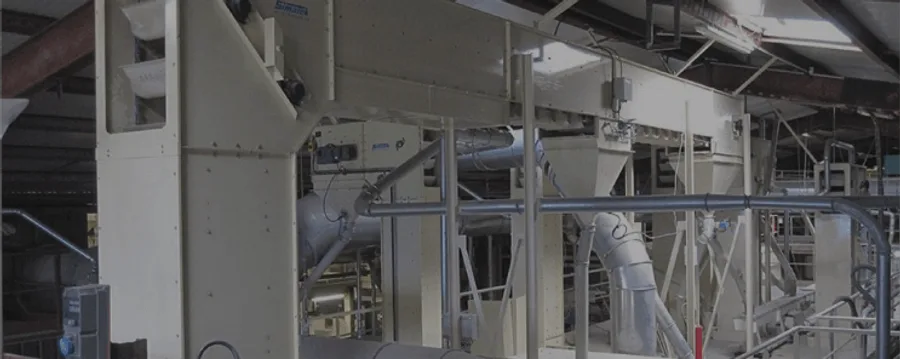
Why Is Multiple Discharge Important in Pet Food and Aquafeed Plants?
In pet food and aquafeed (fish feed) production plants, conveying systems do more than simply move products from one level to another.
Modern production lines may require products from the same process line to be directed to:
- different finished-product silos,
- multiple packaging lines,
- intermediate storage bins,
- different process equipment.
This raises an important engineering question: How can a product be distributed to multiple destinations while minimizing the number of additional conveying and transfer systems?
One of the key features of pendulum bucket elevators (Z-type bucket elevators) is the possibility of incorporating multiple controlled discharge points within a single conveying system.
What Is Multiple Discharge?
Multiple discharge means that a product can be discharged at several selected points along the same conveying system.
In a pendulum bucket elevator, centrifugal force is not required to empty the buckets. Instead, each bucket can be tipped in a controlled manner at a designated discharge point.
This operating principle makes it possible to install several discharge stations along the conveying path.
As a result, a single Z-type bucket elevator can serve multiple silos, bins or process destinations.
Distributing Product to Multiple Destinations with a Single Elevator
Consider a pet food plant where product from one production line needs to be distributed to four different finished-product silos.
In a conventional arrangement, the product may first be lifted to the required level by an elevator. Horizontal conveyors, distributors or diverters can then be used to direct it to the selected silo.
With a pendulum bucket elevator, different discharge points can be integrated directly into the elevator conveying path.
A simplified process flow could be:
Product Inlet → Z-Type Bucket Elevator → Discharge 1 / Discharge 2 / Discharge 3 / Discharge 4
The required discharge station is activated and the product is directed to the selected silo or process.
This provides valuable process flexibility, particularly in plants producing different products on the same production line.
How Does Controlled Discharge Enable Multiple Discharge Points?
The fundamental feature that enables multiple discharge in a pendulum bucket elevator is its controlled discharge principle.
In conventional centrifugal-discharge bucket elevators, product discharge largely depends on the speed and movement of the buckets around the head section.
In a pendulum system, discharge does not have to be limited to the head of the elevator.
The bucket can be tipped in a controlled manner at a suitable discharge station positioned along the conveying path. This allows multiple discharge points to be incorporated into the same system.
As a result, a Z-type bucket elevator becomes more than just vertical conveying equipment; it can also become an integral part of the product distribution system. For a comparison of the different designs, see our article on bucket elevator types.
Multiple Discharge in Pet Food Plants
Pet food production often requires flexibility because of different recipes, kibble sizes and packaging formats.
Multiple discharge can be used for:
- feeding different finished-product silos,
- supplying different packaging lines,
- filling intermediate storage bins,
- feeding different process equipment.
Conveying flexibility becomes particularly valuable when future product variations or additional packaging lines are considered during plant design.
Multiple Discharge in Aquafeed (Fish Feed) Plants
Similar requirements exist in aquafeed production.
A single plant may produce fish feed with different pellet diameters, densities or formulations. These products may need to be directed to different finished-product silos or packaging lines.
Particularly with extruded fish feed, preserving product integrity is important. Reducing unnecessary transfer points can therefore provide an additional advantage.
The multiple-discharge capability of a Z-type bucket elevator allows products to be distributed to different destinations through a single conveying system in a controlled manner.
Fewer Transfer Points
One potential advantage of multiple discharge is the possibility of reducing additional transfer equipment in certain plant layouts.
At each additional transfer point, the product may:
- fall,
- impact a surface,
- change direction,
- be exposed to friction.
For sensitive pet food and aquafeed products, these mechanical effects may contribute to product breakage and fines generation. You can read more about this in our article on breakage and fines in pet food and aquafeed production.
Controlled discharge to different destinations from a single Z-type bucket elevator can therefore help reduce the number of transfers the product experiences throughout the process.
Is Multiple Discharge Necessary for Every Application?
No.
The appropriate conveying system should always be selected by considering:
- required capacity,
- product characteristics,
- conveying distance,
- plant layout,
- number of discharge points,
- cleaning and hygiene requirements.
For some very high-capacity or long-distance applications, other conveying concepts may be more suitable.
However, when handling sensitive products that need to be distributed to several destinations, a pendulum bucket elevator with multiple discharge points can provide an effective alternative.
Conclusion
In pet food and aquafeed production, the role of a conveying system is not limited to lifting products vertically.
Controlled distribution to different silos, process equipment or packaging lines is also an important part of process design.
Pendulum bucket elevators (Z-type bucket elevators) make it possible to incorporate multiple discharge points within a single conveying system through their controlled discharge principle.
Depending on the application, this can help:
- reduce transfer points,
- reduce the need for additional conveying equipment,
- provide more controlled product handling,
- increase production-line flexibility.
Therefore, the question when selecting a conveying system should not only be “How do we lift the product?” It should also be “To which destinations must the product be delivered, and how many transfers are required to get it there?”
Related Technical Articles
- Breakage and Fines in Pet Food and Aquafeed Production: How Conveying Systems Affect Product Quality — Learn how transfer points, conveying speed and free-fall height can influence product breakage and fines generation.
- Handling Oil-Coated Pellets in Pet Food and Aquafeed Production: Advantages of Pendulum Bucket Elevators — Learn why products become more sensitive after oil coating and how controlled conveying can help preserve product quality.
Explore our pendulum bucket elevators →
If you would like to review how many discharge points your plant requires, get in touch with us — our engineering team will prepare a solution tailored to your project.