
Conveying System Design in Pet Food and Aquafeed Plants: How Many Transfer Points Do You Really Need?
How transfer points affect product quality, equipment requirements and plant layout in pet food and aquafeed plants, and why the route is designed as one system.
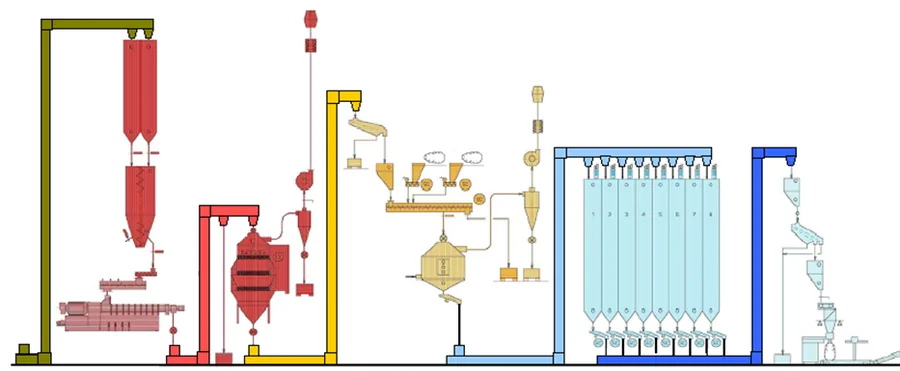
Evaluate the Conveying System as a Complete Route, Not as a Single Machine
When designing conveying systems for pet food and aquafeed (fish feed) plants, capacity is often one of the first considerations.
How many tonnes per hour should the elevator handle? How long will the conveyor be? What vertical lifting height is required?
These are necessary questions, but they are not enough to evaluate the complete conveying system.
As the product moves from one point of the production line to another, it may pass through several pieces of equipment. Each transition from one machine to another can create another transfer point.
For this reason, an important question should be asked during the design stage:
How many pieces of equipment and transfer points do we actually need to move the product from its starting point to all required destinations?
What Is a Transfer Point?
A transfer point is a location where the product moves from one conveying machine to another piece of equipment or process unit.
For example, a conveying system may be arranged as follows:
Bucket Elevator → Conveyor → Distributor → Chute → Silo
Before reaching the destination silo, the product passes through several machines and connections.
At each transfer, the movement of the product may change. The product may fall from a certain height, change direction or enter another conveying machine.
For relatively robust commodities such as grain, this may not create a significant problem in many applications.
Extruded pellets used in pet food and aquafeed production, however, can be more sensitive. Preserving their physical integrity may become particularly important after coating.
Every Transfer Point Introduces Another Mechanical Effect
At a transfer point, the product does more than simply move from one machine to another.
During the transfer, it may experience:
- Free fall
- Impact against surfaces
- Changes in direction
- Friction
- Contact with other product particles or equipment surfaces
The effect of one transfer point may be limited. However, if the product passes through multiple transfers along the same conveying route, these effects can accumulate.
For pellets that are sensitive to mechanical stress, this may contribute to increased product breakage and the generation of fines.
Therefore, it is important to consider not only how gently an individual elevator or conveyor handles the product, but also how many times the product is transferred throughout the complete conveying route.
Free-Fall Height Is as Important as the Number of Transfers
Reducing the number of transfer points alone is not enough.
How the product moves from one machine to another is equally important.
A short, controlled transfer does not have the same effect as a transfer involving several metres of free fall.
As the free-fall height increases, the product can reach a higher impact velocity, potentially increasing the mechanical stress on the pellets.
For this reason, two questions should be considered together when designing a conveying system:
How many transfer points are there?
and
How does the product move through these transfer points?
The objective is not simply to reduce the number of machines, but to maintain a controlled product flow throughout the conveying route.
The Price of One Machine Is Not the Same as the Cost of the Complete System
When conveying solutions are compared, investment cost is often considered on a machine-by-machine basis.
For example, the prices of two different bucket elevator concepts may be compared directly.
However, the price of the elevator alone does not represent the total project cost.
A complete conveying line may include:
- Bucket elevators
- Horizontal conveyors
- Distributors or diverters
- Chutes
- Supporting structures
- Motors and gearboxes
- Electrical and automation equipment
Every additional machine may also require installation, electrical connections, controls, maintenance and spare parts.
Therefore, when comparing two conveying concepts, the question:
“How much does the bucket elevator cost?”
should be considered together with:
“What equipment do we need in total to move the product to all required destinations?”
How Can Z-Type Bucket Elevators Affect System Design?
Pendulum bucket elevators, also known as Z-type bucket elevators, can combine horizontal and vertical conveying sections within one system.
Multiple controlled discharge points can also be incorporated along the conveying route.
Depending on the plant layout, these characteristics may allow functions that would otherwise require a separate vertical elevator, horizontal conveyor and distribution system to be combined into a simpler conveying concept.
For example, where product from one production line must be distributed to several finished-product silos or bins, the conveying system can be designed around this requirement from the beginning.
In some applications, this can reduce the need for additional conveying equipment and transfer points.
However, this does not mean that a Z-type bucket elevator will require fewer machines in every project.
Capacity, conveying distance, plant geometry, product characteristics and the location of the required discharge points all have a direct influence on system design.
Are Fewer Transfer Points Always Better?
The objective is not to use the minimum possible number of machines.
The objective is to eliminate unnecessary transfers.
In some processes, a separate conveyor or distributor may be technically necessary. Long conveying distances, high capacities or the plant layout itself may require different conveying technologies to be used together.
Therefore, system design cannot be based solely on minimizing the number of transfer points.
A more appropriate approach is to evaluate:
product characteristics + capacity + conveying route + discharge points + process requirements
together and develop the most suitable conveying concept for the application.
Consider the Conveying System Early in Plant Design
Conveying equipment is sometimes considered only after the locations of process machines, silos and packaging lines have already been determined.
The conveying system then becomes a way of connecting these predefined points.
In some projects, however, this approach can result in unnecessary conveying distances and additional transfer points.
Particularly when designing a new pet food or aquafeed plant, it can be beneficial to evaluate product flow together with the overall plant layout.
- Where does the product come from?
- Where does it need to go?
- How many different products or formulations will be handled?
- Does the same conveying line need to supply several destinations?
- Where will free fall occur?
Answering these questions before selecting the individual machines can help create a simpler and more controlled product flow.
Conclusion
Conveying system design in pet food and aquafeed plants is not simply a matter of selecting the right bucket elevator or conveyor.
The complete route followed by the product through the production plant should be evaluated.
Every transfer point can introduce free fall, impact or a change in direction. At the same time, every additional conveying machine becomes part of the investment, energy consumption, automation and maintenance requirements of the plant.
Therefore, instead of asking only:
“Which bucket elevator should we use?”
it is also worth asking:
“How can we move the product from its starting point to all required destinations through the simplest and most controlled route?”
In some projects, the answer may be a conventional combination of bucket elevators and conveyors. In others, pendulum bucket elevators (Z-type bucket elevators) capable of combining horizontal and vertical conveying with multiple discharge points may provide a simpler conveying concept.
The important point is not to start with a particular machine, but to design the complete product route as one system.
Related Technical Articles
- Breakage and Fines in Pet Food and Aquafeed Production: How Conveying Systems Affect Product Quality — Explore how conveying speed, free-fall height and transfer points can influence product breakage and fines generation.
- Multiple Discharge in Pet Food and Aquafeed Plants: Advantages of Z-Type Bucket Elevators — Learn how one conveying system can distribute product to different silos, bins and process destinations through controlled discharge.
- Handling Oil-Coated Pellets in Pet Food and Aquafeed Production — Explore why maintaining product integrity becomes particularly important when conveying coated pellets.
- Conveying System Design in Pet Food and Aquafeed Plants: How to Reduce Transfer Points — Learn how reducing transfer points affects plant layout and product quality.
Explore our pendulum bucket elevators →
If you would like to evaluate your plant’s product flow and transfer points together, contact us — our engineering team will prepare a conveying concept tailored to your project.