
Hygienic Conveying in Pet Food and Aquafeed Plants: Sanitary Design and CIP Bucket Elevators
Explore Sanitary Design, washable bucket elevators and CIP systems for controlling product residues and improving hygiene in pet food and aquafeed plants.
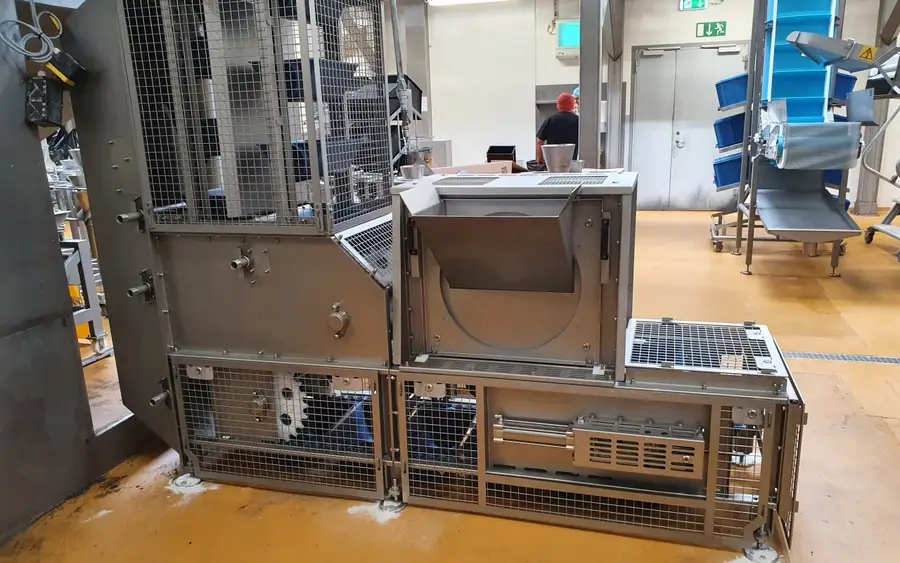
The Next Step in Hygienic Conveying: The Cleaning Concept
In pet food and aquafeed (fish feed) plants, evaluating conveying equipment from a hygiene perspective goes beyond the surfaces that come into direct contact with the product.
The amount of residual product remaining inside the system after production, accessibility for cleaning and the cleaning method itself are also important considerations.
In our previous article, we discussed product residues, cleanability and cross-contamination risks in conveying equipment.
This leads to the next question:
How should the conveying equipment be cleaned? Is dry or manual wet cleaning sufficient, or is a CIP system required?
There is no single answer. The appropriate cleaning concept depends on product characteristics, production processes and the hygiene requirements of the plant.
What Is Sanitary Design?
The design of conveying equipment has a direct impact on cleaning operations.
It is important that potential product residues can be identified, relevant product-contact areas can be accessed and the equipment can be inspected and cleaned as effectively as possible.
In the Sanitary Design version from Simatek Bulk Systems, the elevator features an open-frame stainless-steel construction. The system is designed to facilitate both manual dry and wet cleaning.
The open construction provides an important advantage for inspection and cleaning. Instead of enclosing critical areas within a closed casing, relevant sections of the equipment can be accessed more directly.
For this reason, hygienic design is not simply about the material used. Accessibility and cleanability are also fundamental parts of the design.
Dry Cleaning or Wet Cleaning?
Not every pet food or aquafeed application requires the same cleaning method.
In some processes involving dry and free-flowing products, regular dry cleaning may be sufficient.
For applications requiring more extensive cleaning due to product characteristics, oil content or plant hygiene procedures, wet cleaning may be considered.
Simatek Sanitary Design is designed for both manual dry and wet cleaning.
The objective is not necessarily to select the most extensive cleaning system available, but to determine the level of cleaning actually required by the process.
What Is CIP?
CIP stands for Cleaning-In-Place.
In general, the purpose of CIP is to clean defined product-contact areas using an integrated cleaning procedure without requiring extensive dismantling of the equipment.
However, washable equipment and a CIP system are not necessarily the same thing.
With manual wet cleaning, an operator cleans accessible areas of the equipment. With a CIP solution, specific cleaning operations can be performed using equipment integrated into the system.
This distinction becomes particularly relevant in processes where cleaning is required frequently.
How Does the Simatek CIP System Work?
For applications requiring automatic cleaning, Simatek Sanitary Design elevators can be equipped with an optional CIP washing station. According to Simatek’s technical information, this solution is specifically intended for the automatic cleaning of buckets and chains.
The distinction can therefore be summarized as follows:
- Sanitary Design → manual dry or wet cleaning
- Sanitary Design + CIP → automatic cleaning of buckets and chains
CIP should therefore not be considered a replacement for sanitary design. Instead, it is an additional solution for applications with higher or more frequent cleaning requirements.
Why Can CIP Be Important in Pet Food and Aquafeed Plants?
Pet food and aquafeed plants often produce different formulations and product types on the same production line.
During product changeovers, residual material from the previous production run may be carried into the next product.
Small product particles or fines remaining within the system can re-enter the product flow when production restarts.
For this reason, cleaning requirements should not be evaluated only according to visible product residues. Buckets, chains and other relevant product-contact areas within the conveying system should also be considered.
Automatic cleaning solutions such as CIP can be particularly relevant in processes where cleaning needs to be carried out regularly and consistently.
Cleaning Oil-Coated Pellets
In pet food and aquafeed production, oils or other liquid components may be applied after extrusion and drying.
Oil coating changes not only the conveying characteristics of the product but also the cleaning requirements of the equipment.
Oil together with fines may adhere to equipment surfaces and create residues that are more difficult to remove than residues from dry products.
Two questions should therefore be considered together when designing a conveying system for oil-coated pellets:
- How can the product be conveyed gently?
- How will the conveying system be cleaned after production?
Addressing both questions early in the project can help avoid cleaning solutions that are difficult to implement after the equipment has already been installed.
Manual Cleaning or CIP?
CIP is not required for every application.
The appropriate solution should be determined according to process conditions.
For example, manual cleaning may be sufficient in an application where product changeovers are infrequent and the required hygiene level can be achieved through dry cleaning.
In contrast, frequent product changeovers, products with a tendency to adhere to surfaces or higher cleaning requirements may make automatic cleaning solutions more relevant.
Therefore, the first question should not be “Do we need CIP?”
Instead, it should be “What level of cleaning does this process require?”
Hygienic Design Is More Than CIP
CIP is an important technology, but it is only one element of a hygienic conveying system.
The overall equipment design, material selection and accessibility for cleaning must also be considered.
The stainless-steel open-frame construction of Simatek Sanitary Design and its suitability for manual dry and wet cleaning provide the basis of this approach. Where automatic cleaning of buckets and chains is required, an optional CIP washing station can be added.
For this reason, a hygienic conveying system should be evaluated as a combination of design + accessibility + cleaning method, rather than on the basis of a single feature.
Hygiene Requirements Should Be Defined at the Beginning of the Project
When designing a new pet food or aquafeed plant, the cleaning concept should not be considered only after the conveying equipment has been selected.
At the beginning of the project, several factors should be defined:
- Characteristics of the products being conveyed
- Whether oil coating is involved
- Frequency of product and formulation changeovers
- Required cleaning method
- Plant hygiene procedures
This makes it possible to select between a standard conveying system, Sanitary Design or a CIP-equipped solution according to the actual process requirements.
Conclusion
Hygienic conveying in pet food and aquafeed plants means more than simply using stainless-steel equipment.
Control of product residues, accessibility for cleaning and selection of the appropriate cleaning method should be evaluated together.
Simatek’s Sanitary Design provides an open-frame stainless-steel construction suitable for manual dry and wet cleaning. For applications requiring a higher level of automatic cleaning, an optional CIP washing station can provide automatic cleaning of the buckets and chains.
The relevant question is therefore not only “Which bucket elevator should we use?”
The following question should also be answered during the design stage:
“How will we operate this elevator during production, and how will we clean it afterwards?”
This approach allows conveying and hygiene requirements to be considered as integral parts of the same process design.
Related Technical Articles
- Hygienic Conveying in Pet Food and Aquafeed Plants: Why Is Cleanability Important in Bucket Elevators? — Explore how product residues, cleanability and cross-contamination risks affect conveying system design.
- Handling Oil-Coated Pellets in Pet Food and Aquafeed Production — Learn how oil coating affects product handling characteristics and gentle conveying requirements.
- Breakage and Fines in Pet Food and Aquafeed Production — Explore how conveying speed, transfer points and free-fall height can affect product integrity.
Explore our pendulum bucket elevators →
If you would like to review the cleaning concept and hygiene requirements of your plant together, get in touch with us — our engineering team will prepare a solution tailored to your project.